"Mangos, Mojitos, and Completely Blissful Escapism"
Club Med Ixtapa, Mexico
May 17th, 2010
www.rsthurston.com
*Make sure to check out the slideshow at the bottom of this posting
After a lifetime spent traveling to developing world countries and living on the cheap, I've always eschewed the idea of resorting it and spending a week or two comfortably cut off from the local culture while sipping fancy drinks and surrounded by my similarly situated socioeconomic and national kinsmen. Well it turns out that this form of travel is called "vacation" and that it's actually quite enjoyable! I had NO IDEA how amazing the experience of resorting it could be.

By sheer fortune, my boyfriend's parents offered to take us and his brother, sister-in-law, and nephew all to spend a week at Club Med in Ixtapa, Mexico. And all I can say is OH.MY.GOD. AMAZING! I think that the older I get the more I appreciate the art of relaxation and learning to spend an afternoon doing absolutely NOTHING! Club Med also provides ample opportunities for guests to stay active if you're not entirely content reading Girl With The Dragon Tattoo and drinking endless glasses of cool, sweet minty mojitos under a private palapa on the beach (I know…it sounds rough, doesn’t it?).
From the morning into the late evening, you can choose from Zumba Classes (one of my favorite activities…a Latin/Hip Hop style of really popular cardio-exercise), tequila tastings, Body Sculpting, Archery, Trapeze/Circus Classes, Tennis, Rock Climbing, Body-Surfing, Kayaking, Sailing, Swimming, and Cooking Classes with the top chefs from the resort. At night you have your pick of checking out an incredible variety of dancing performances, hilarious skits playing off of movies and pop culture music, and an unforgettable finale circus performance.
Then there’s always the option of just staring thoughtfully into the Pacific sipping on a Pina Colada as you contemplate whether you’ll be going with the Beef Tenderloin and mushroom sauce for dinner or the grilled Mahi-Mahi with a side of fresh mango and lime juice.
Or you can do both. Whichever way…it’s all about the options you have at Club Med!
We were especially blown away by a the quality of food and drinks that we indulged in day after day....homemade spinach stuffed ravioli, fresh ceviche, mouthwatering slices of mango, papaya, and watermelon, endless trays of freshly made fruit tortes and pastries, cinnamon and sugar-dusted churros, imported cheeses, hand-rolled tortillas and pre-hispanic dishes, stir-fried vegetables, and Moroccan, Mexican, Chinese, and Italian themed dinners.
The staff was also incredible to us…I can’t say enough amazing things about the quality of service we had there. Another one of Club Med’s philosophies is that guests are treated like royalty but that they have a chance to interact and become friends with the staff, who hang out, eat, and drink with the guests at the meals and parties. I feel a special affinity for many of the staff that we got to know there over the course of the week and want to send out a special thanks to several of them:
A huge THANKYOU to Eduardo (operations manager), Daniel (bar and entertainment), Asaia (hosting), Sandra (boutique), Nat (incredibly talented head of entertainment….amazing trapeze artist and comedian as well!), Jona (hilarious impressions of Ricky Martin and self-professed ‘shy guy’…), Chefs Sheik, Miguel, and Arturo (who taught some super fun cooking classes and treated us like royalty while we were there….including an amazing fruit masterpiece you’ll see in the slideshow!). Big thankyous also to all of the dancers, choreographers, costume designers, A/V guys, trapeze artists, cooks, bakers, bartenders, and groundskeepers that give it 150% on a daily basis.
You guys couldn’t have done a more amazing job or made our experience there more amazing!
Thankyou! Gracias! Merci! Cheers! Obrigado! I highly, highly recommend going to Ixtapa, Mexico or trying out another Club Med. In the meantime, for a little taste of paradise...enjoy the slideshow I put together for Steve's family as A HUGE THANKYOU for affording us with this opportunity!
ENJOY THE SLIDESHOW!
Monday, May 17, 2010
Saturday, April 05, 2008

Tulum, Mexico (Yucatan Peninsula)
"Mid Thirties Wanderlust Crisis"
Is it possible that a self-professed adventurer could actually be sick of travelling?
How is it that I am with the love of my life in a tropical location with gorgeous views of the Caribbean, enough sun to melt Greenland´s ice caps away, and an agenda-less week and actually yearning to be home in Santa Barbara with a hot shower, my kitty kats, my laptop, and endless access to wi-fi. Hell, I have friends who'd give their left pinky to be here right now on 'vaction' in a place like this.
Yet I'm hot, sticky, and covered with so many bug bites that my upper back looks like a Braille version of "Beowolf." Slathered in a potent concoction of citronella bug juice and cheap candy-scented sunblock mixed with sweat, I've been grumpy until tonight. Annoyed by the sand that's been blowing into our cheap, sand-floor bungalow...the fact that our hotel doesn't even have the pride to repair our broken windows and instead replaces them with ripped netting....never cleans the communal shower or toilets....and has the greedy audacity to advertise its "flotation chamber" which we later learn doesn´t actually have any water at all! Are you kidding me?! Why not slap a slab of butter on a waffle cone and call it ´ice cream?´
I call it "Feco-Tulum" cause they offer you a bunch of crappy services, slap an "eco" label on it and then sell it to you at a premium. The showers are actually ocean water they pump out straight. They don't have electricity.
They should call it "Copal: Just like camping only sandier, windier, dirtier, and more expensive!"
So back to my original fear. Is it possible that I'm getting burnt out on travel? What if, instead of just needing a ´break´ from travel, I´m actually losing my edge and becoming soft. Becoming, dare I venture to ask, "high-maintenance?" I used to brag about being able to sleep on a windshield and camping out on rocks without sleeping pads. When I did use one I was fiercely loyal to a quarter inch pad that had been torn a bit and written on when it was separated from me on a river trip. Years later, I graduated to a thicker therma rest pad with ridges. I prided myself on never having a blow up pad. Now I have an awesomely comfortable inflatable and most times, I'd just prefer to return at the end of the day to my own bed.
So am I going soft? Like my sleeping pads....is it going to be a slow degradation of my adventurous spirit? Or is this just a phase? After travels to Indiana and back for the holidays and sleeping on a deflated air mattress on a cold slab of concrete beneath three dogs and a cat to riding for days across the Sahara in a mini-van to driving across the Mojave Desert twice to visit my Mamacita to braving the mozzies on Isla Holbox...I just feel, simply, tired.
The thought of another bus ride, another haggering for a taxi ride, another delayed plane ride in which "paperwork has to be completed" and we, the passengers, are grounded without food or water for two hours before we even take off....the thought of another afternoon spent dragging myself along a dirt street beneath a searing sun trying to find the best deal on a hotel room in a resort area where the peso has risen and the dollar has fallen....I think I´ve about had enough.
Friday, April 04, 2008

Isla Holbox, Yucatan Peninsula, Mexico
Feels like I'm on the set of Pirates of the Caribbean...off-the-beaten-path island North of the Yucatan Peninsula...staying down the coast from a town made of dirt streets, golf carts instead of cars, Italian street-side cafes, and miles of blindingly-white sand set against a turquoise ocean. Staying with my boyfriend's family at a gorgeous, peaceful eco-resort that's solar run surrounded by fuscia blossoms of bougainvillea, Madagascar periwinkle, and a giant iguana named Oscar.
Falling into island-time...sleeping to the rhythm of palm fronds clicking against the sides of our hut, the whir of the ceiling fan, silhouette of our mosquito netting, the salty fragrance of hot tropical air, the tingle of cool saltwater on sun-baked skin, the softness of cotton sarongs against your legs, mango smoothies served in giant glasses, crushed mint mojitos at sunset, and aimless wandering down streets of pastel homes....peach, lemon, coral, mint, tangerine, carnation....swimming in cenotes (blueholes) where pirates once quenched their thirst....fingers dripping with mango juices...melting in your mouth like sun-ripened butter....
Tuesday, March 28, 2006
"Twelve Things That Might Surprise You About Mexico..."
Just in case you might be one of those gringos who thinks that all Mexicans bear bottles of Jose Cuervo, sing “La Cucaracha,” and wear giant sombreros, I’ve created a list of twelve things that might surprise you about our Latin neighbor to the South…
1) The word, "Mexico," is Nahuatl (the ancient Aztec language) and means "the belt of the moon." It was originally pronounced as "Meshico" as the Nahuatl 'x' actually makes a 'sh' sound.
2) Located along the eastern side of the world’s “Ring Of Fire,” Mexico isn’t just known for its fiery latin culture, its landscape is literally a hotbed of geologic activity. Mexico’s center is cut in half by a volcanic mountain chain, Cordillera Neovolcanica, which contains several active volcanoes and the country’s highest peaks. You can take advantage of this thermal activity by climbing one of the volcanoes or by visiting hot springs throughout central Mexico like we did in San Miguel de Allende or in other towns surrounding Mexico City.
3) One of the largest countries in the world (the 14th to be exact), Mexico encompasses the extreme aridity of the Chihuahua Desert, two major mountain ranges, the rainforest of the Yucatan, and vast coastlines along the Caribbean Sea, Gulf of Mexico, Pacific Ocean and the Sea of Cortez.
4) Chili peppers, squash, beans, chocolate (which comes from the cacao bean), and corn (belonging to the grass family and originally only a couple of inches in length) all originated in this part of the world. The Aztecs once used chocolate and chili peppers to blend into a hot drink that was very unlike the Nestle hot chocolate—made with milk and copious quantities of sugar—that we drink today.
While chocolate is indigenous to Mexico, it is used more often in cooking the traditional Oaxacan moles (a satisfying and labor-intensive sauce used on chicken made with cinnamon, chocolate, nuts, and raisins) and for preparing hot drinks than it is enjoyed in its American candy bar counterpart.
5) Mexico City is the second largest city in the world and is home to the second largest public meeting place (Tianamen Square in Beijing is the largest), the zocalo, or central plaza. Sixty percent of Mexicans are mestizo, a mix of indigenous and European heritage, thirty percent are indigenous peoples (Mayan, Zapotec, Mixtec, etc.), and around ten percent are Caucasian of European descent.
6) It is estimated that 25 million people inhabited the this region (Texas, New Mexico, Arizona, Mexico and the northern part of Central America) of the New World in 1519 when the Spanish conquistadores arrived. 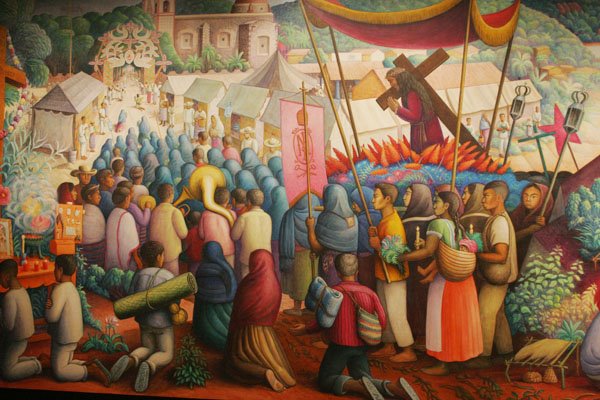 In less than a hundred years, this same population had fallen to one million people, the vast majority decimated by European diseases to which they had little resistance.
7) We can’t forget about tequila, the most wonderful libation from the ancient gods. There are actually three drinks native to Mexico, all made from different agave plants: tequila (a liquor made from the blue agave), mescal (a smokey tequila-like liquor made from agave using traditional methods and generally produced on a smaller scale than tequila), and pulque (a milky, low-alcohol beverage made on a small, community-based scale from the maguey agave).
The photo to the right shows me sucking the aguamiel (sweet inner liquid) from a maguey agave up through a hollowed-out gourd.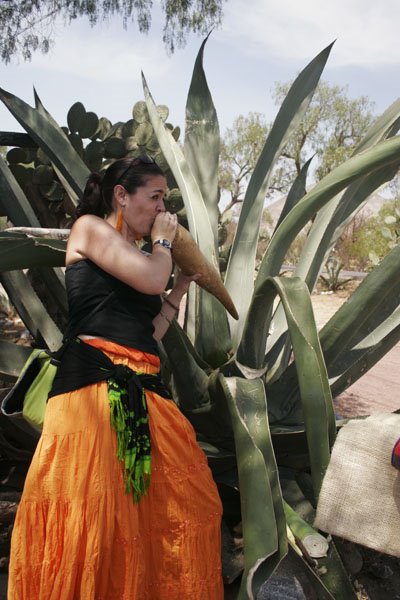 Traditionally, people would then spit this liquid into barrels where the liquid would be fermented for several days to several weeks. From my experience, the low-alcohol content pulque has a sweet, fruity, and slightly fizzy flavor.
(source: http://www.ianchadwick.com/tequila/pulque.html)
A short history of pulque: Made as long ago as 200 B.C., pulque was used by Teotihuacan priests to put themselves into trances and to help anesthestize human victims of sacrifices. One little known fact is that for five days before a man was going to be sacrificed, he was given all the girls he could enjoy, pot he could smoke, and pulque he could imbibe. On the morning he was to be sacrificed, he was also given peyote to help with the pain (an obsidian knife was used to slit him open and to retrieve his still beating heart to be offered to the sun god) and to ease his transition to the afterlife.
The clincher?
Women who were to be sacrificed were given none of these drinks or drugs to take away the pain. That’s right ladies, the woman had no anesthesia when they were sacrificed. Hostal Moneda guided tour with birthday girl.
FYI: The Teotihuacan people believed in an ancient Nirvana-like heaven in which men and women were assured of two absolutes: all the water they needed and all the pulque they could drink.
8) The Mixteca and the Teotihuacan People believed that the gods of darkness and the sun were constantly at war, and that if they didn't 'feed' the god of the sun, that day would never come the next morning...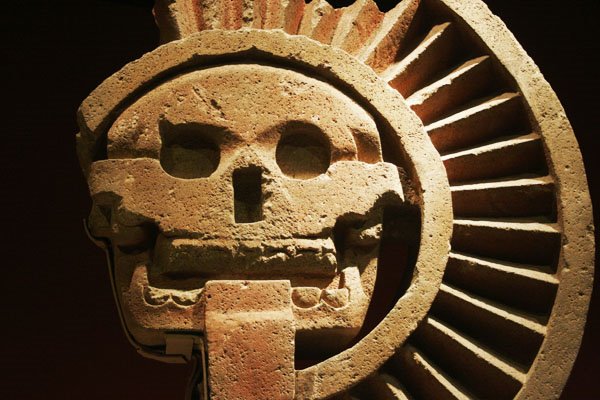 they facilitated human sacrifices twice a day on giant slabs of stone in front of two pyramids dedicated to the sun and the moon. The man or woman's heart was cut out while it was still eaten and a part of their flesh was eaten and then offered.
9) The city of Teotihuacan (east of Mexico City), meaning “The City of Gods” or “The Place Where Men Become Gods,” was built nearly two thousand years ago by a group of people pre-dating the Aztecs (to this day, their ethnic origin and languages are unknown). At the height of its power, Teotihuacan was the largest city in all of the New World (that includes all civilizations in both South and North America, folks) and it was the sixth largest city in the world (larger than any city in Europe) supporting a population of 125,000–200,000 people. (sources: http://www.world-mysteries.com/mpl_7.htm and http://archaeology.asu.edu/teo/)
10) Teotihuacan’s Sun Pyramid is the third largest pyramid in the world.
11) Several award-winning films have recently been filmed in Mexico: Frida (with Salma Hayek), Traffic (Steven Soderbergh’s film), Once Upon A Time In Mexico, Amores Perros, and El Mariachi (starring Antonio Banderas and Salma Hayek and made by Robert Rodriguez in two weeks for just $7000). Lonely Planet: Mexico.
12) Mexico City was built on a giant lake bed, which the Mixteca People (who later came to be known as the Aztecs) arranged into an extensive system of canals used for irrigation and transportation. Today, over 180 kilometers of these canals remain and visitors from around Mexico can hire boatmen to take them along the canals while feasting on pollo con mole negro, cold beers, and live music.


Friday, March 17, 2006

Mexico City...
Cathy and I took a 3.5 hour bus ride to Mexico City, the second most populated city in the world, where I got in my first fight of the trip with a bastard of a bus station taxi worker. During our bus ride we had just read an ominous two-page crime section vehemently warning how many of the taxis in Mexico City are actually taxis stolen by criminals planning to victimize tourists and Mexicans alike. In 2003, the US State Department proclaimed that “Robbery assaults on passengers [in Mexico City taxis] are frequent and violent, with passengers subjected to beating, shootings and sexual assault.”
The Lonely Planet: Mexico guide suggests that you demand to only take a taxi sitio with an orange stripe and an “S” at the beginning of the license plate instead of a taxi libre which is a little less secure and more likely to be stolen by bandits intent on robbing you. We paid our pesos to a secure taxi service and were taken outside by one of their workers. He took us to a taxi line and brusquely directed us to one of the taxis.
We both looked at the license plate and the car. No orange stripe and no “S.” It was a taxi libre, a bit less secure than what we had paid for. I looked down the line where a Mexican gentleman was being directed to a taxi sitio with an orange stripe, the exact type of taxi we wanted.
“We need another taxi.”
“What do you mean?”
“We want an ‘S’ taxi.”
“Why” he started to yell at us, waving his arms at the long line of taxis behind us, “They’re all the same!”
“We want an S taxi.” I told him again, beginning to feel like a high-maintenance American. I knew, however, that both of our mothers would want us being obstinate when it comes to our own safety. Better safe than sorry, especially after a two-page crime section on taxi hustling in Mexico City.
The taxi driver had gotten out of the car and was watching the argument now.
“Well, this isn’t an S taxi but it’s yours and you have to go in it anyway,” the worker told us.
I tried to size the taxi driver up from ten feet away and I wondered if I could really tell if he was a thug intent on raping us just on looks and first instincts alone, but that’s probably not the best way to make safe decisions as a woman in the third world.
“No, we don’t have to take this taxi,” I turned to face the irate taxi worker.
“Yes, you do!” he said. “This one’s yours. There are many other people waiting. JUST GET IN THE CAR!”
He obviously hadn’t dealt with a strong-headed Aries before and now the B**ch was coming out.
“We’ll just wait here for another taxi then. Someone else can take this one.”
“Listen,” he said yelling at me in Spanish and shaking his finger at me, “I’m not fucking around here, I have to work and make a living.”
He stormed off, telling all of his friends what a pain in the ass we were being.
Now most men, most honest men, even if they were right about what they were telling me (that there’s no difference between a taxi libre and a taxi sitio, which is a complete lie), would recognize the concern of two young American woman getting into an unknown taxi after reading about the crime among taxi drivers in Mexico City. But not this one, he was a supreme asshole.
The pendejo tripped one of those rare wires in my genetic makeup and really started to piss me off. I wanted to punch him out.
“We’re not fucking around either!” I yelled back at him in Spanish as he stood with a group of men badmouthing us. “We’re two women and we have to be careful when we’re traveling….and we’re not taking this taxi.”
I led Cathy back inside to the kiosk to demand that someone else help us. My heart rate was racing. It’s rare that I get angry but I refuse to compromise when it comes to our safety.
We were promptly taken by another man to another taxi, a sitio taxi driven by a nice man who took us directly to our hotel and not to an abandoned warehouse parking lot….
All the way to our hotel, our hearts were racing with fear that we weren’t heading in the real direction of the city now. We were both so grateful to arrive at our exact location. We still don’t know what might have happened if we’d gone with the other driver.
Alls well that ends at your hotel, I’d like to say about taxis in Mexico City.
---------------------------------------------------------------------------------
Our hostel (Hostel Moneda) was minimally decorated but its location and value were excellent. We only paid $30 a night ($15 each) for a private room and bathroom just a block off of the zocalo, or central plaza of historic downtown Mexico City (dorm beds only cost 10 bucks!). Along with our room’s price was included free internet use, free tours to the local museums, discounts on tours to the pyramids, AND, our favorite, FREE breakfasts and dinners (salty, starchy, but filling) on their rooftop terrace and bar overlooking the zocalo and Mexico City.
Another enticing aspect to the splendid view of the cathedral and city lights was eating among some awfully damn fine looking backpackers from Israel, Europe, and America (Hirschegger, eat your heart out!). Unfortunately, Cathy and I both realized in the bright glare of the daylight, that most of the cute backpackers were young enough to be our nephews. One sweet Austrian guy developed a crush on Cathy and kept finding us to ask about visiting her in the states one day.
Within hours of our arrival we decided to push our comfort zones a bit and ride the metro through the heart of Mexico City AT NIGHT. It was a rude awakening to ride the metro in Mexico City after walking among a sea of gringos in San Miguel de Allende. We bought our 50 cent tickets and became enveloped in a wave of Mexicans during the heart of rush hour traveling for hours to get back to their homes. Sweaty people pushed up against us and fought for space on the metro whenever the doors opened at each stop.
It was incredibly humid and stuffy but didn’t feel terribly unsafe, just crowded and uncomfortable. We didn’t see any other foreigners among thousands of faces.
During the day, the city took on an entirely different face. Mexico City, like Los Angeles but twice the size and population, is made up of dozens of different neighborhoods with their own distinct personalities. Our favorite area was Coyoacan, where Frida Kahlo and Diego Rivera lived, loved, painted, and entertained their friends. Their “Casa Azul” was an inspiring complex circling a courtyard and filled with their books and art collections that inspired their life’s work.
Coyoacan’s streets were lined with giant trees and purple jacarandas in full bloom. The central plaza was filled with hip, alta cocina restaurants, bars, and cafes where an intellectual and artsy community of Mexicans gather to socialize.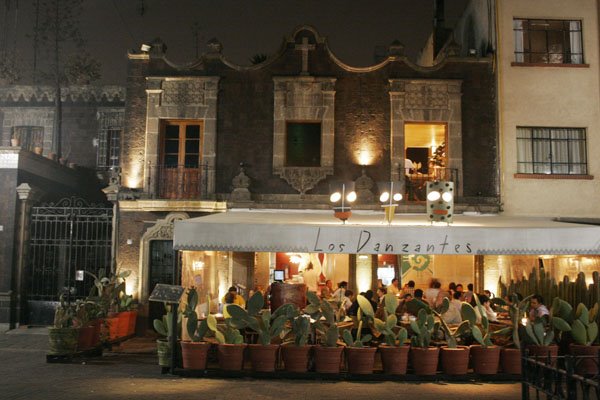 We ate exquisite meals….delicate pinwheels of chicken stuffed with squash flower blossoms and cheese in a white wine cream sauce with fresh herbs, churros and hot chocolate, chipotle fondue, and a banana, sweetened condensed milk and cinnamon crepe to celebrate my birthday later this month.
In the afternoon (while Cathy worked at a copy shop on her imminent move to the East Coast), I strolled through the market looking at fresh fruit, vegetables, and papier mache flower garlands made to celebrate the coming spring.
The streets in Mexico and throughout Latin America are lined with street vendors, a part of what’s referred to as the unregulated “informal economy.” This is what I love about Mexico. Buying hot churros off the street. Buying beaded necklaces handmade by a woman from Puebla for $4.
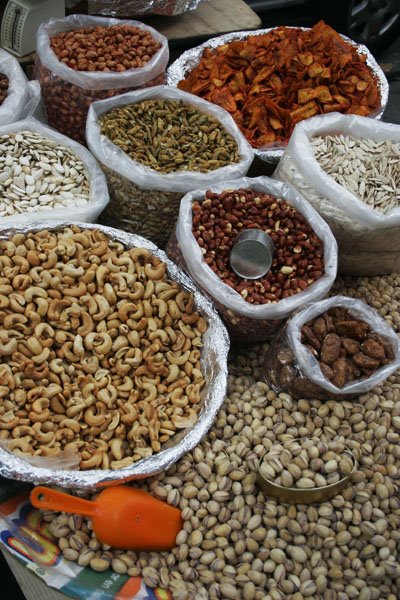
I talked to a grandmother selling giant bags of nuts in every color, shape, and flavor which she had roasted and flavored herself and piled into a giant wheelbarrow cart: Salted peanuts, toffee peanuts, chile and lemon peanuts, pumpkin seeds, sweet pumpkin seeds, banana chips, chile banana chips, cashews, spicy cashews….
I bought three bags filled with banana chips and sweet pumpkin seeds (my favorite!) for 45 pesos ($4.50). We shared all three bags with everyone on our tour group the next day.
____________________________________________________________
During the hottest day of the week we had the bright idea to go visit Teotihuacan, a famous ancient city containing the third largest pyramid in the world, and one of the largest and most impressive pre-hispanic civilizations in the New World.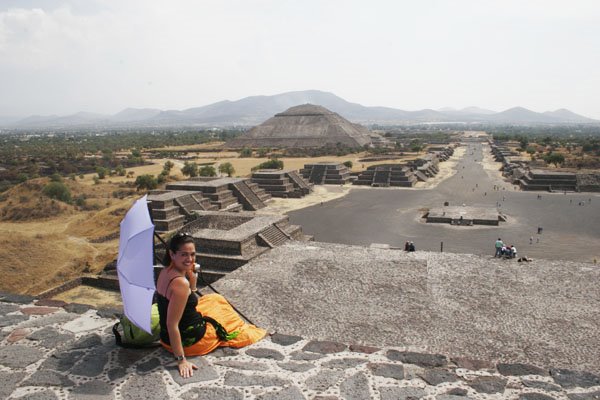
In a nutshell, Teotihuacan is an enigma to anthropologists and archaeologists alike. During the height of its power, Teotihuacan was the sixth largest city in the entire world and eclipsed the size and expansiveness of all other European cities at that time. It was home to anywhere from 125,000 to 200,000 people of which we know very little. During the eighth century, the city was burnt and destroyed and there’s little evidence why. Although we know much about the structures, archaeologists have no idea what language these people spoke and who they were the descendants of: they actually preceded the Aztecs, who later named the city, “City of the Gods” or “The Place Where Men Became Gods.”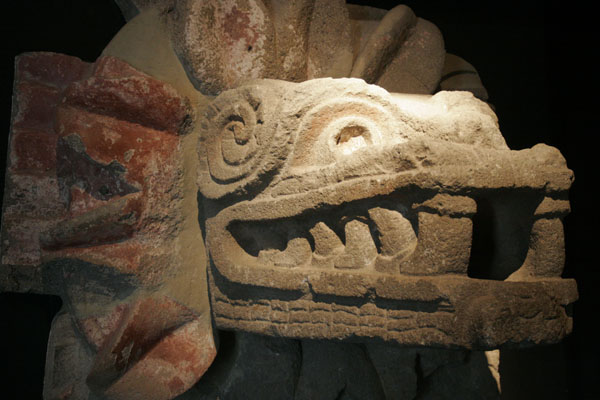 Like the Aztecs, the people of Teotihuacan believed in regular human sacrifices. The people of Teotihuacan believed that, unless they appeased the god of the sun, that the sun would not come the following morning. Cool idea to read about now but it sucked if you were a virgin maiden or prestigious warrior at the time. Priests conducted human sacrifices twice a day, once at sunset and once at sunrise. Some humans sacrificed were volunteers and others were chosen because of their prestige in the city or because they were being punished for having broken a law (like drinking the alcoholic beverage pulque, which was outlawed until you turned 52 years old).
Those that volunteered to be sacrificed believed that their passage to heaven would be expedited. In the Teotihuacan version of heaven, two things were certain: they’d have all the water they needed and they’d have an infinite supply of pulque with which to intoxicate themselves.
WARNING: the following paragraph is graphic:
During the ritualized sacrifices, the priests would lay the man, woman, or child out on a slab and cut their stomach open with a long obsidian knife. They would then pull the victim’s heart out while it was still beating. I won’t get any more graphic than this but I’ll just say that, according to our guide, the Mexican dish posole was originally made with human flesh.
Another mystery of Teotihuacan, besides their sudden downfall (hmm, how about a revolt by a bunch of woman saying, “what the f&*%? Why don’t we try a day without any human sacrifices and let’s see if the the sun still comes up tomorrow? Then we’ll know if you priests are all full of s**t.”) is that the pyramids contain a layer made from thick slabs of Brazilian mica which was brought from over 2,000 miles away. This would be inconceivable if not for the fact that the people of Teotihuacan didn’t use the wheel in any of their construction (They believed that using the image of their Sun God was sacreligious and would anger him).
That night as we walked back to our hostel, we passed several groups of people reenacting the Aztecs’ (who lived and developed the valley which would become Mexico City) dances to live drumming. They wore seeds around their ankles and shins and waved sage smoke over their bodies much like the Native Americans do in the U.S.
On our last day we took an afternoon boat ride along the canals of Xochimilco. Unbeknownst to many Americans, Mexico City was built by the Aztecs on a giant lake bed which they arranged into a network of canals and an extensive irrigation system. Today, over 180 kilometers of these canals remain and Mexicans from around the country descend on these lanchas to hire mariachi bands and boat guides to take them along the tree-lined canals past farms and small homes. 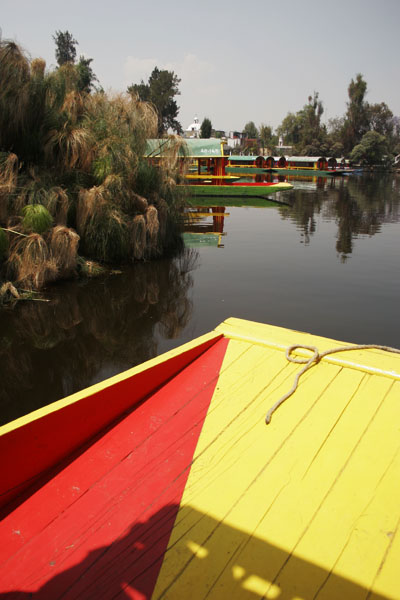
 Since there was no one else around at the time, Cathy and I hired a whole boat for ourselves for $30 (which could have accommodated twenty-five of our best friends and several bottles of tequila and a mariachi band) to linger for a while in the shade from the afternoon sun. We floated to a small farm where a man came on board and offered us lunch. We chose the best pollo con mole negro (made with chilies, cinnamon, nuts, raisins, and Mexican chocolate) that I’ve had this past year, a plate of hot corn tortillas, and frijoles.
We bought roasted corn with chile and lime from a man selling straight from his canoe. Elote (the Mexican word for corn) is the one thing that ironically, I think really sucks in Mexico. It’s usually tough, tasteless, and smothered in mayonnaise. I don’t get it, especially since corn is indigenous to Mexico and you’d think they’d get it right.
I wanted to like this old guy’s corn. He had his little wood stove and this giant heap of beautiful white corn lying perfectly lined up in a heap with a bowl of freshly cut limes. I’m a corn fed Hoosier girl so if there’s one thing I know, it’s a good piece of corn on the cob that pops in your mouth with its sweet crispness.
And let me tell you, the corn on the cob in Mexico sucks. And so did his. But we ate it, wished him good luck for the afternoon in his business, and thanked him for the corn.
On our last day in Mexico City, our taxi driver was late picking us up to take us to the bus station for our return to San Miguel de Allende.
He explained that our timing to leave was bad because today was “street cleaning” day and that we’d have to walk two blocks to get to his taxi, since the authorities wouldn’t let him park on any of the nearby streets. We didn’t really get the origin of his annoyance until we turned a corner down one of the streets.
There were dozens of men and women shouting, laughing, and brooming giant suds across the wet street. Cathy and I gingerly navigated our way in flip flops across the street which had momentarily become a river of suds and dirty water.
A young guy in a muscle shirt rode on top of a giant truck gleefully aiming a firehose at anyone left out in the street. If someone escaped his aim and darted across the street, he’d changed positions and spray them down on the other side of the street before they could escape.
It was a pretty fun scene until we realized that, like everyone else, we were trapped, too, and had nowhere to go to escape THE HOSE.
I felt like I was trying to dodge deadly lazer blasts in War of the Worlds. I was carrying everything that means anything to me in my backpack (including my trip journal and my photo hard drive with 1500 photos from our trip in Mexico). To make matters worse, my precious Canon 20D digital camera was dangling around my neck, unprotected and exposed.
We narrowly missed his spray, ducking into a courtyard just in time as the water pelted several young girls instead. As soon as the truck had passed, everyone moved out into the street again pushing the suds along with their brooms.
A couple of guys shouted to us as we walked past. They were getting a kick out of watching two gringas trying to balance our backpacks as we slipped along in flip flops beneath our monstrous loads.
“Guera! Guera! Mamacita! Come here and kiss me!” they called out to us.
I was trying not to think about all the bodily fluids and junk that must be floating over my ankles when I heard a loud slap behind me. A spray of water hit my skirt and the back of my legs.
One of the guys who had been running after us had slipped on the soap and fallen right on his back in two inches of water. His friends had forgotten about the two clumsy gringas and were laughing their butts off at him instead.
I had to laugh at the guy, too. He looked like an upturned turtle.
What I love about Mexico is that you never know what’s going to happen next. The best approach is to always have a healthy sense of humor.
And really good flip flops.
Con amor,
Raquelita
Monday, March 13, 2006
Buenas tardes from San Miguel de Allende, 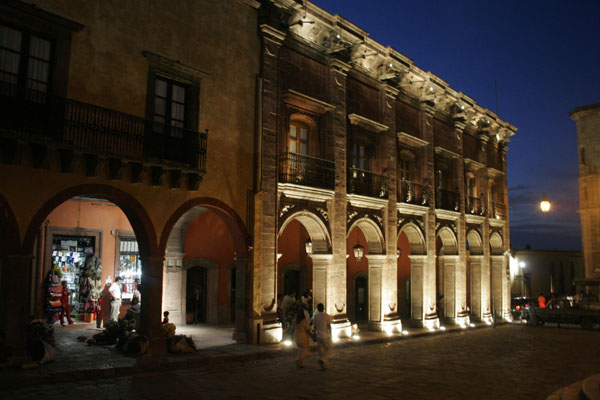
It's always difficult trying to figure out at what point to write one of my travel blogs but I realize that my Red Bull has almost run out and Mexico will soon be behind us. I'm also about to kill the American girl sitting at the computer beside me.
"How do you change this to English?" she's yelling to the cafe staff, "I CAN'T READ SPANISH! I have to check my savings account and have more money wired out here. What you expect me to do, learn Spanish?!"
I'm about to unleash the Custer (Mama Chihuahua's side of the family) fury on her. I'm ready to lean over and give her a good slap, "Wake up! You're in f-ing Mexico!"
So, back to Mexico...
For the first three days of our trip, the four of us (Cathy, Andrea, Brian, and I) explored the expatriate colonial Mexican pueblo of San Miguel de Allende. Robert Rodriguez shot his recent film "Once Upon A Time In Mexico" starring Antonio Banderas here. Situated in a desert valley surrounded by the mountains, this sixteenth century town is in the state of Guanajuato and is a photographer and artists' dream in its flourishment of color: cobblestone streets lined with high end art galleries, churches, plazas, and brightly-colored adobe buildings.
San Miguel feels a bit like the gringo's revised and romantic notion of Mexico, its edges are much more polished, the streets are clean and safe, and although incredibly beautiful, it lacks the distinctly Mexican edge that the rest of the country has where gringos are in shorter supply. You get the sense here that the foreigners want to believe that this is "their" Mexico and that they have it all to themselves. It's a "safe" Mexico and not as rough or as real as other parts of the country. But the quality of the food, art, and music is noticeably high and I can easily see the allure for retirees, musicians, painters, and writers to come here to live out the rest of their years. It's also the perfect play to visit for a couple of days to unwind and gorge yourself on damn good food. 
The four of us had the unique opportunity to stay in a gorgeous condo that some friends of mine (Rob and Laura) from Santa Barbara own....a two story adobe structure with red-tiled roofs and artistic flourishes in each of the rooms: Chunky, hand-carved beds, colorful hand-woven rugs, and balconies off of each of the bedrooms overlooking the valley and the mountains. At sunset, the walls of the condo looked velvety and sumptuous....framed by trailing vines of fuschia bougainvillea, orange blossoms, and potted geraniums. I could easily go back to San Miguel just to write and take photos, never leaving their home. It's an incredibly romantic place to go in every sense of the word.
We spent days feasting on "chilaquiles" (strips of tortilla strips fried with cheese, chicken, and red and green salsa),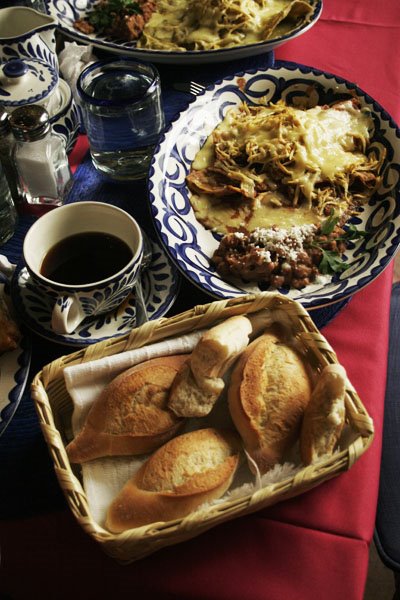 "huevos tirados" (scrambled eggs with chorizo, black beans, and cheese) and fresh corn tortillas, chicken with "mole negro" (a chocolate and nut-based sauce), green chili and chicken tamales, and chicken in an almond, white wine, and poblano chile sauce. To die for! Many of the hip restaurants also offer live music while you eat...flautists, guitar players, accordian players, and singers.
We heard through the grapevine that the 'IT' spot to go for late night ambience is "San Agostin's," a cafe owned by a Mexican ex-porn star. The place is plastered with photos from her long career in Mexican film and in Playboy issues. The canary yellow cafe rings with laughter and intimate conversation as couples and families linger over cups of Mexican hot chocolate and "churros" (long deep-fried breadsticks rolled in cinnamon and sugar) served straight from the oven. I've never considered myself much of a sweet tooth...but I'm a churro-lover after this trip! 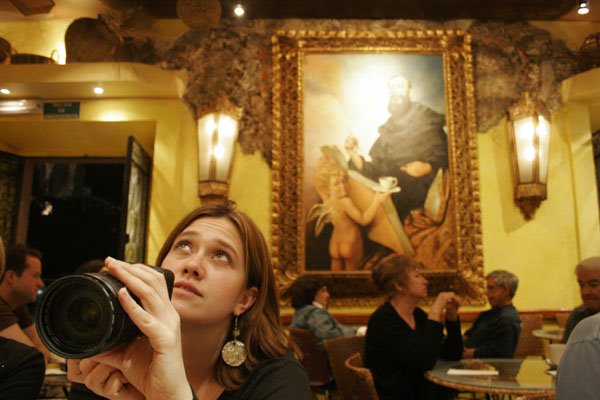
On Saturday night we ran into Juan, the owner of a new Mexican Harley biker bar. He dragged us into the bar for the rest of the night. The underground bar was a cross between the Robert Rodriguez/Quentin Tarantino movie "From Dust Til Dawn" and Cold Spring Tavern on a Sunday afternoon. I made the mistake of telling him that I'm a singer. Before I knew it, Juan had the whole bar full of Mexican bikers chanting "RAQUELRAQUELRAQUEL!!! Cante! Cante! CANTE!"
The guitarist was a skinny guy who kept downing shots of tequila in between a halting mix of The Beatles, The Eagles, and Los Lobos. Before we started playing together, Juan brought out a giant bottle of tequila and poured several shots down my mouth and the guitarist's mouth. The guitarist spit a mouthful of tequila out onto a wall across the other side of the room like a Mexican firehose and was applauded by all the bikers as the greatest drinker and "sprayer" of the night.
We decided to play Bonnie Raitt's "Someone To Love" because, although he'd never really heard of the song, it's a simple blues progression. Unfortunately, by the time I began singing, my head was spinning from the tequila and the guitarist had lost any rhythm which he still had. He decided to take a guitar solo in the middle of one of my verses. He sprawled out on his back and tried to play the guitar behind his head to even more applause from all the bikers.
By midnight, I got all the women in the bar to come up and sing back-up to a song that none of us knew but all decided could be improved upon with some occasional "oooohs" and tequila-induced "howls." By the end of the song, we forget what we were singing cause the howling was much more fun and we didn't know the words anyway.
Towards the end of the night, Andrea and I did our Salt n' Pep rap, which is somewhat of a tradition for me to sing on as many continents as possible. Hip Hop evidently isn't a favorite among Mexican bikers judging from the blank stares and the half-hearted applause. Fortunately however and judging from the attention they gave us, the bikers much preferred two cute gringas rapping a song they don't know to listening to a drunk, skinny Mexican guitarist singing the Eagles off-key.
Needless to say, slipping out of the bar after midnight was the greatest challenge of the evening. The four of us had to half-heartedly promise that we'd be back the following night. (We weren't...we have to pace ourselves after all.)
On the following afternoon, the four of us hired a taxi to take us out into the desert to recover from the night before and to visit some natural thermal pools for the afternoon. San Miguel, like much of Mexico, is geologically active and has an array of hot springs. We lied on the grass along a lake beneath eucalyptus trees with the warm smell of the desert wind brushing over us in between visits to the underground thermal pools.
On day three, Andrea and Brian headed back to Los Angeles and Cathy and I continued on to Mexico City for Part II of our Mexican Adventure...
stay tuned...
con amor,
Raquelita, the queen of Tequila
Friday, February 03, 2006
I'll be heading to San Miguel de Allende and then on to Mexico City for several days in March. A couple of friends will be joining me in lieu of Mama Chihuahua this time so it will be a different sort of trip...less shopping and more tequila.
I've heard through the grapevine during this past year that Mexico City is becoming one of the hippest, most cosmopolitan new IT cities to visit these days. I'll be exploring the best taco stands in the city and searching for a fabulous plate of the national dish (and my very favorite comida), "Chile en Nogada," chile peppers stuffed with meat and fruit in a walnut nougat sauce and sprinkled with pomegranate seeds. Because it's red, white, and green—the color of the Mexican Flag—it's been affectionately deemed their national dish.
Stay tuned for more culinary, tequila, and trekking adventures.
Monday, January 16, 2006

"High Levels Of Lead found in Oaxacan Grasshoppers"
Little did I know...and they were so tasty!
For those of you who have read my latest blog "Ten Things to Do In Oaxaca," be aware that there was a recent article in the San Francisco Chronicle cautioning the risk of lead poisoning found in Mexican foods like chilies, candies, and....grasshoppers. It's not yet known why the grasshoppers have been found with such high levels of lead but one theory suggests that Oaxaca's factories and chemical run-offs play a role. Thank you to my girlfriend and fellow writer Christy Harrington for the tip! Hopefully, I haven't had my IQ points drastically lowered from a few handfuls of the crunchy little guys...
You can find the article on www.sfgate.com, written by Carolyn Jones on 1/15/06 for the San Francisco Chronicle.
E-mail Carolyn Jones at carolynjones@sfchronicle.com with questions.
Wednesday, January 11, 2006

Thursday, December 22, 2005

Ten Good Things To Do In Oaxaca Besides Watch T.V. and stuff yourself with tortillas:
1) Try some crunchy "chapulines" or grasshoppers seasoned with chile, salt, and lemon. It´s believed that if you eat one, you will return to Oaxaca one day. (We ate at least five of them each--a bit crunchy and flavorful but not as good as popcorn)
2) Go to a Mezcal "fabrica" and watch how the famous tequila-related liquor is made. Chew on the freshly fermented leaves (they taste like baked pumpkin with brown sugar). Gulp down a "gusano" worm with your shot of Mezcal. Distinguished from tequila which is made from the blue agave and produced on an industrial level, Mezcal has a hardy, smoky flavor. Many Mezcal stores also produce "Crema de Mezcal" liqueurs (coconut, almond, peach, cafe flavors) for gringos who can´t stomach the Mexican liquor straight.
3) Visit the Zapotec rug-making pueblo of Teotitlan to learn how the famous wool is dyed using natural plants and insects. "Cocchineal" is a cactus-loving worm/insect which is ground up to create a deep crimson natural dye. Compounds like lemon, salt, and water are mixed with the cocchineal to create up to 45 other colors which the Teotitlan artisans use to dye their wool and weave into exquisite designed rugs.
4) Hike in the mountains through the pine forests and through "bosques" of white moss. "Los Pueblos Mancomunados" is an excellent area of the Sierra Norte to base a multi-day trek along pre-hispanic roads and Zapotec trails which wind through villages, forests, and fields of agave, corn, and small family-run orchards and a trout farm.
5) Visit a chocolate "fabrica" and watch chocolate beans, cinnamon, and sugar being ground up to create Oaxaquenan chocolate. Order several different types of hot chocolate with straws and share with a friend!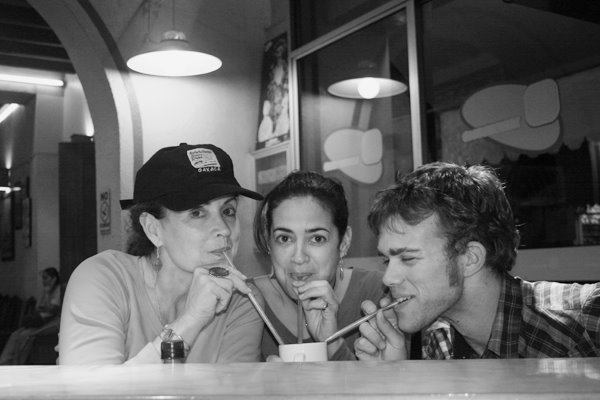
6) Wander the "zocalo" or central plaza at night and watch for live music, salsa/flamenco/tango dancing, and local entertainment.
7) Have lunch at "El Mercado Juarez." After wandering the stalls of chocolate, mole, fruits, nuts, spices, and breads, sit down for a "pollo con mole negro," made with chocolate, nuts, chiles, and dried fruit, or try a "tlayuda," or Oaxaquenan style giant tortilla--stuffed with frijoles, carne, locally-made cheese, tomatoes, and onions--folded in half and grilled.
8) Visit any of the local ruins like Mitla or Monte Alban where the ancient human sacrificial ceremonies make "Indiana Jones and The Temple Of Doom" seem like a Disney movie.
9) Go to a festival. Any festival. Although Christmas is a splendid time of year to visit, with festivals occuring almost every day, each pueblo has its own celebrations throughout the year to celebrate their patron saint. Another good time to visit is during "Dia De Los Muertos" when Christianity and pagan traditions mix in a festive and wonderfully macabre celebration of life and the afterlife.
10) Eat as much as possible. Get lost in Oaxaca city late at night and buy from one of the moving "Cocinas" which appear once it gets dark. (We just discovered an eighty year old woman last night whose "cocina" appears on a street west of the plaza. Her customers have been coming to eat her "Tlayudas" for over forty years now. She has someone help her push her cart of cooking supplies to the same spot every night.
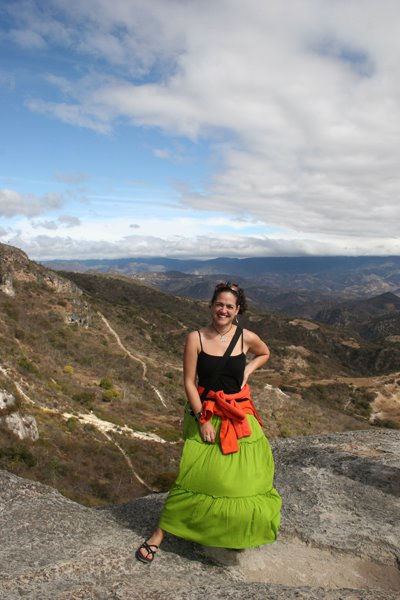
11) Visit "Hierva del Agua," a petrified waterfall and mineral hot spring, perched on the edge of the mountains with an extraordinary 270 degree view of the surrounding mountain ranges and Valle de Oaxaca. Grab some water and a Tlayuda, sit back, and breathe the warm high desert air and appreciate one of the finest views in Mesoamerica...
Wednesday, December 21, 2005

Adventures in The Land Of Seven Moles...
December 21, 2005
Oaxaca, Mexico
I´ve been rather remiss in writing during this trip because we´ve been so busy. There´s so much to absorb here and we´ve been away in the mountains for a couple of days...from eating grasshoppers at the market to trekking between villages and wandering through the Zapotec markets, we´ve hand our little gringa hands quite full with all things Oaxaquena!
But first, a quick fact flash on the state of Oaxaca. This state is rich with indigenous groups, the Zapotecs comprising the majority near the capital city. Oaxaca boasts 16 distinct indigenous languages and a staggering diversity of cultural groups. For centuries it has developed and retained its own distinct languages, cultural customs, and cuisine unique in Mexico. I´ve felt more comfortable traveling here as a woman than any other Latin American country. In the colonial city of Oaxaca, you can walk around by yourself at any time of night and feel completely safe. The feel are wonderfully amable and tranquila!
Oaxaquenan Comida:
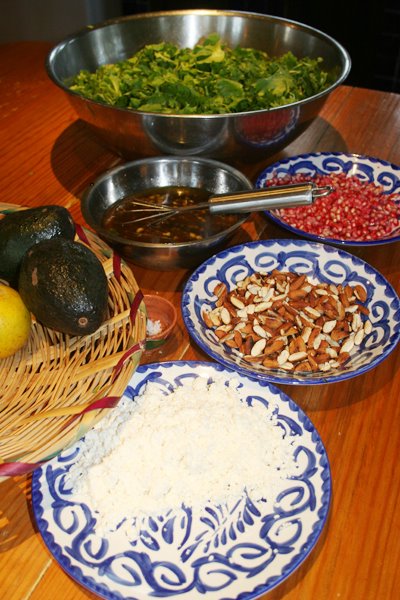
The main square looks European from its colonial roots and the smaller pueblos are lined with cobblestone streets. World-renowned for its cuisine, Oaxaquenan food is the best of almost all cuisine in Mexico. Chocolate comes from this area and the Zapotecs have been using it in their dishes and drinks for centuries. Also famous are their multiple mole sauces made from chocolate, various fruits and nuts, guajillo chilies, tomatoes, onions, and spices. On the second day here, we attended a cooking class out in the country where we slow-cooked chicken marinated in mole negro and wrapped in banana leaves, ricotta and drunken raisin stuffed crepes with a sweet potato and pineapple sauce, and fresh organic greens drizzled with a citrus dressing, toasted almonds, fresh farm cheese, and pomegranate seeds.
We´ve wandered through the markets tasting as many different dishes as possible...including toasted whole grasshoppers spiced with chile and limon. My favorites have been the "tlayudas" or Zapotec style quesadillas which are large toasted tortillas grilled and filled with a red chile sauce, frijoles, avocado, tomato, and onions, and meat of your choice. Other favorites have been "mole negro con pollo" or the "entomatodos" which are corn tortillas soaked in a home-made tomato-garlic-chili sauce and garnished with cilantro, onions, and fresh queso.
Every other street corner are mescal stores which give free tastings of locally-produced mescal (different from tequila which is made from blue agave). Bars of chocolate are also sold around the pueblos and city for making Oaxaquenan hot chocolate with milk. Sabrosa!
The Trekking:
We were fortunate enough to have chosen the newest Lonely Planet guide to Mexico which just recently added a section on "Los Pueblos Mancomunados," a group of eight Zapotec villages in the Sierra Norte mountain range which, for centuries, have pooled their resources to glean an income from selective foresting and ecotourism. They have a network of trails which connect the villages and adobe cabanas for trekkers to stay in.
From the very start, we were impressed by their organization and dedication to sharing and teaching extranjeros about their history and villages. We began trekking at around 9500 feet through pine forests along clear mountain streams, the air sweet and pure. We hiked along dirt roads lined by giant seven foot tall agaves which dwarfed us. past farmers hand-cutting their fields of corn, small groups of goats with their baby cabritas, and along steep ridges with views that stretched across other mountain ranges.
Part of the trail between two of the villages followed a cobblestone pre-hispanic road that dates back several centuries. Our guides (who are required because of the circuitous routes through the forest) offered us "pulque," a local liquor made from the larger agaves and tasting a bit like fizzy apple cider) and had us taste various fruits and herbs we came across on our trek.
Giant pine and deciduous trees dripped with wispy strands of "musco blanco" or "white moss" which clung to branches like feathery cobwebs, lending a whimsical feeling to the forest. Bromeliads grew from trees above hillsides of agave and prickly pear. I´ve never seen anything like the botanical mix there.
We spent our evenings in small villages eating out of local kitchens where women cooked over open fires. Plates of "entomatados," frijoles, potatoes with chilies, and "huevos mexicanos" served with hot tortillas. The women would boil milk or water and mix it with bars of chocolate (traded for from the city for their corn) until it was frothy. We would fall asleep to the sound of a crackling fire in our bunk beds, laughing about how relative the word "flat trail" is to the Zapotec.
My legs were in such pain at the end of our three day trek that I limped for two days when we returned to Oaxaca City. At our hostel, I had to descend stairways backwards because my calves were in such pain.
Yesterday we joined other travelers for a tour of local Zapotec ruins, a mineral bath hot spring and petrified waterfall, and a mescal distillery.
Mom and I have been getting along smashingly (except for one small fight on our trek) and her Spanish continues to improve daily. We both wake up in the morning, our heads swimming with thoughts and fragments in puro espanol. We´ve met many travelers from Germany, Australia, Italy, Mexico, and only a few Americans-one of whom is from Santa Barbara ironically!
The American and I discovered a local bar called "La Cucaracha" which offers a fine selection of mescal, tequila, beer, and tapas. Several of us stayed out until early morning listening to a local guitarist who is incredibly talented and plays some very familiar Mexican music which Antonio Banderas sang in "Desperado."
The waiter there has taken quite a shine to me. He´s handsome, suave, bright, and about four and a half feet tall. If I remained sitting down our relationship could work. :)
At night, Mom and I wander through the plaza and markets, hot chocolates in hand, tasting new foods, and listening to Mexican Christmas carols sung in front of the iglesia.
Last night as we walked back to our hotel, our hands full with hot chocolates, fresh french fries bought from a street vendor, and a pastry, Mamacita complained that her apple pie wasn´t salty enough and I lamented that we are going to miss the famous Radish Festival this weekend.
Traveling is rough indeed. Espero que todos de ustedes disfruten todos los dias de esta temporada! I hope each of you are enjoying every day during this holiday season!
Con much amor, Raquelita and her Mamacita