

Ten Good Things To Do In Oaxaca Besides Watch T.V. and stuff yourself with tortillas:
1) Try some crunchy "chapulines" or grasshoppers seasoned with chile, salt, and lemon. It´s believed that if you eat one, you will return to Oaxaca one day. (We ate at least five of them each--a bit crunchy and flavorful but not as good as popcorn)
2) Go to a Mezcal "fabrica" and watch how the famous tequila-related liquor is made. Chew on the freshly fermented leaves (they taste like baked pumpkin with brown sugar). Gulp down a "gusano" worm with your shot of Mezcal. Distinguished from tequila which is made from the blue agave and produced on an industrial level, Mezcal has a hardy, smoky flavor. Many Mezcal stores also produce "Crema de Mezcal" liqueurs (coconut, almond, peach, cafe flavors) for gringos who can´t stomach the Mexican liquor straight.
3) Visit the Zapotec rug-making pueblo of Teotitlan to learn how the famous wool is dyed using natural plants and insects. "Cocchineal" is a cactus-loving worm/insect which is ground up to create a deep crimson natural dye. Compounds like lemon, salt, and water are mixed with the cocchineal to create up to 45 other colors which the Teotitlan artisans use to dye their wool and weave into exquisite designed rugs.
4) Hike in the mountains through the pine forests and through "bosques" of white moss. "Los Pueblos Mancomunados" is an excellent area of the Sierra Norte to base a multi-day trek along pre-hispanic roads and Zapotec trails which wind through villages, forests, and fields of agave, corn, and small family-run orchards and a trout farm.
5) Visit a chocolate "fabrica" and watch chocolate beans, cinnamon, and sugar being ground up to create Oaxaquenan chocolate. Order several different types of hot chocolate with straws and share with a friend!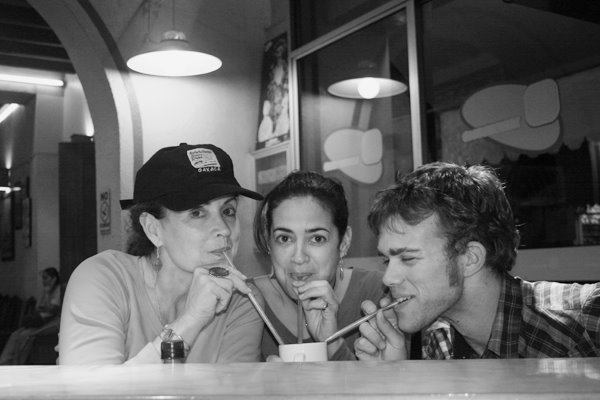
6) Wander the "zocalo" or central plaza at night and watch for live music, salsa/flamenco/tango dancing, and local entertainment.
7) Have lunch at "El Mercado Juarez." After wandering the stalls of chocolate, mole, fruits, nuts, spices, and breads, sit down for a "pollo con mole negro," made with chocolate, nuts, chiles, and dried fruit, or try a "tlayuda," or Oaxaquenan style giant tortilla--stuffed with frijoles, carne, locally-made cheese, tomatoes, and onions--folded in half and grilled.
8) Visit any of the local ruins like Mitla or Monte Alban where the ancient human sacrificial ceremonies make "Indiana Jones and The Temple Of Doom" seem like a Disney movie.
9) Go to a festival. Any festival. Although Christmas is a splendid time of year to visit, with festivals occuring almost every day, each pueblo has its own celebrations throughout the year to celebrate their patron saint. Another good time to visit is during "Dia De Los Muertos" when Christianity and pagan traditions mix in a festive and wonderfully macabre celebration of life and the afterlife.
10) Eat as much as possible. Get lost in Oaxaca city late at night and buy from one of the moving "Cocinas" which appear once it gets dark. (We just discovered an eighty year old woman last night whose "cocina" appears on a street west of the plaza. Her customers have been coming to eat her "Tlayudas" for over forty years now. She has someone help her push her cart of cooking supplies to the same spot every night.
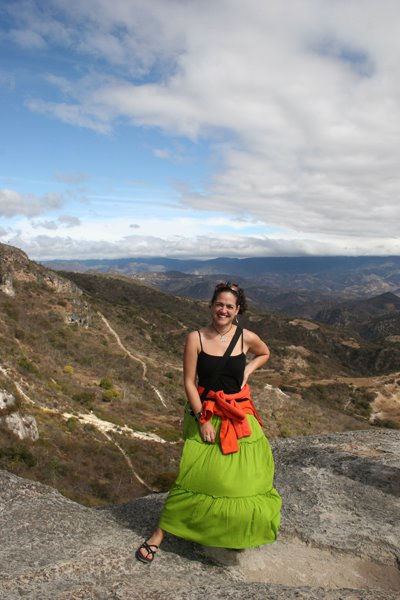
11) Visit "Hierva del Agua," a petrified waterfall and mineral hot spring, perched on the edge of the mountains with an extraordinary 270 degree view of the surrounding mountain ranges and Valle de Oaxaca. Grab some water and a Tlayuda, sit back, and breathe the warm high desert air and appreciate one of the finest views in Mesoamerica...
Thursday, December 22, 2005
Wednesday, December 21, 2005

Adventures in The Land Of Seven Moles...
December 21, 2005
Oaxaca, Mexico
I´ve been rather remiss in writing during this trip because we´ve been so busy. There´s so much to absorb here and we´ve been away in the mountains for a couple of days...from eating grasshoppers at the market to trekking between villages and wandering through the Zapotec markets, we´ve hand our little gringa hands quite full with all things Oaxaquena!
But first, a quick fact flash on the state of Oaxaca. This state is rich with indigenous groups, the Zapotecs comprising the majority near the capital city. Oaxaca boasts 16 distinct indigenous languages and a staggering diversity of cultural groups. For centuries it has developed and retained its own distinct languages, cultural customs, and cuisine unique in Mexico. I´ve felt more comfortable traveling here as a woman than any other Latin American country. In the colonial city of Oaxaca, you can walk around by yourself at any time of night and feel completely safe. The feel are wonderfully amable and tranquila!
Oaxaquenan Comida:
The main square looks European from its colonial roots and the smaller pueblos are lined with cobblestone streets. World-renowned for its cuisine, Oaxaquenan food is the best of almost all cuisine in Mexico. Chocolate comes from this area and the Zapotecs have been using it in their dishes and drinks for centuries. Also famous are their multiple mole sauces made from chocolate, various fruits and nuts, guajillo chilies, tomatoes, onions, and spices. On the second day here, we attended a cooking class out in the country where we slow-cooked chicken marinated in mole negro and wrapped in banana leaves, ricotta and drunken raisin stuffed crepes with a sweet potato and pineapple sauce, and fresh organic greens drizzled with a citrus dressing, toasted almonds, fresh farm cheese, and pomegranate seeds.
We´ve wandered through the markets tasting as many different dishes as possible...including toasted whole grasshoppers spiced with chile and limon. My favorites have been the "tlayudas" or Zapotec style quesadillas which are large toasted tortillas grilled and filled with a red chile sauce, frijoles, avocado, tomato, and onions, and meat of your choice. Other favorites have been "mole negro con pollo" or the "entomatodos" which are corn tortillas soaked in a home-made tomato-garlic-chili sauce and garnished with cilantro, onions, and fresh queso.
Every other street corner are mescal stores which give free tastings of locally-produced mescal (different from tequila which is made from blue agave). Bars of chocolate are also sold around the pueblos and city for making Oaxaquenan hot chocolate with milk. Sabrosa!
The Trekking:
We were fortunate enough to have chosen the newest Lonely Planet guide to Mexico which just recently added a section on "Los Pueblos Mancomunados," a group of eight Zapotec villages in the Sierra Norte mountain range which, for centuries, have pooled their resources to glean an income from selective foresting and ecotourism. They have a network of trails which connect the villages and adobe cabanas for trekkers to stay in.
From the very start, we were impressed by their organization and dedication to sharing and teaching extranjeros about their history and villages. We began trekking at around 9500 feet through pine forests along clear mountain streams, the air sweet and pure. We hiked along dirt roads lined by giant seven foot tall agaves which dwarfed us. past farmers hand-cutting their fields of corn, small groups of goats with their baby cabritas, and along steep ridges with views that stretched across other mountain ranges.
Part of the trail between two of the villages followed a cobblestone pre-hispanic road that dates back several centuries. Our guides (who are required because of the circuitous routes through the forest) offered us "pulque," a local liquor made from the larger agaves and tasting a bit like fizzy apple cider) and had us taste various fruits and herbs we came across on our trek.
Giant pine and deciduous trees dripped with wispy strands of "musco blanco" or "white moss" which clung to branches like feathery cobwebs, lending a whimsical feeling to the forest. Bromeliads grew from trees above hillsides of agave and prickly pear. I´ve never seen anything like the botanical mix there.
We spent our evenings in small villages eating out of local kitchens where women cooked over open fires. Plates of "entomatados," frijoles, potatoes with chilies, and "huevos mexicanos" served with hot tortillas. The women would boil milk or water and mix it with bars of chocolate (traded for from the city for their corn) until it was frothy. We would fall asleep to the sound of a crackling fire in our bunk beds, laughing about how relative the word "flat trail" is to the Zapotec.
My legs were in such pain at the end of our three day trek that I limped for two days when we returned to Oaxaca City. At our hostel, I had to descend stairways backwards because my calves were in such pain.
Yesterday we joined other travelers for a tour of local Zapotec ruins, a mineral bath hot spring and petrified waterfall, and a mescal distillery.
Mom and I have been getting along smashingly (except for one small fight on our trek) and her Spanish continues to improve daily. We both wake up in the morning, our heads swimming with thoughts and fragments in puro espanol. We´ve met many travelers from Germany, Australia, Italy, Mexico, and only a few Americans-one of whom is from Santa Barbara ironically!
The American and I discovered a local bar called "La Cucaracha" which offers a fine selection of mescal, tequila, beer, and tapas. Several of us stayed out until early morning listening to a local guitarist who is incredibly talented and plays some very familiar Mexican music which Antonio Banderas sang in "Desperado."
The waiter there has taken quite a shine to me. He´s handsome, suave, bright, and about four and a half feet tall. If I remained sitting down our relationship could work. :)
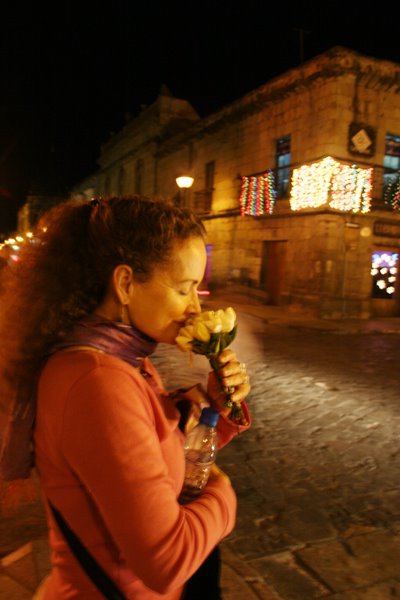
At night, Mom and I wander through the plaza and markets, hot chocolates in hand, tasting new foods, and listening to Mexican Christmas carols sung in front of the iglesia.
Last night as we walked back to our hotel, our hands full with hot chocolates, fresh french fries bought from a street vendor, and a pastry, Mamacita complained that her apple pie wasn´t salty enough and I lamented that we are going to miss the famous Radish Festival this weekend.
Traveling is rough indeed. Espero que todos de ustedes disfruten todos los dias de esta temporada! I hope each of you are enjoying every day during this holiday season!
Con much amor, Raquelita and her Mamacita
Monday, December 05, 2005
Thursday, December 01, 2005

Thursday, June 02, 2005

“My Absolutely, Very Last Farewell From China!”
6/2/05
I know I’ve already sent out my “farewell” and final email from China but I’ve awoken at 5 in the morning with jet lag and feel compelled to better articulate my experiences in China. There has been so much to process in this past month. New worlds have unfolded in our mind’s eye across the Pacific Ocean, new friendships forged, and adventures which have sharpened my appreciation of the comforts of life in America.
But most of all, I feel the strong urge to set straight several of the stereotypes which I, at the very least, had of China before we set out on this trip.
So here they are, the short and the skinny of travel in China:
--First of all, the dollar is weak in most places around the world. China is the ideal place to travel if you want your dollar to stretch further than you ever dreamed! We easily ate huge meals for a mere $2 or less in both the cities and the countryside. The most expensive and lavish hotel room we ever booked was $27 a night. And there were silk flowers on our beds at night. Most hotels and guesthouses ranged from $4 a night/double in the smaller towns to $15/double in the larger cities. Jade, silk, handcrafts, and scroll watercolor paintings are very inexpensive if you know how to bargain and enjoy it at the same time! I can honestly say that China is the cheapest country that either Mom or I have visited in the world.
The Chinese yuan will be re-evaluated this summer in relation to the American dollar. Prices will be slightly higher but, I believe, that China will continue to be one of the best places for travel while the dollar is so weak.
--It’s incredibly easy to travel as a woman in China. Women are not openly disrespected—at least on the most superficial of levels—as travelers like I have experienced in other countries. Contrary to travel through Latin America, Africa, and some small Asian countries, I was never “cat called” or “ogled” in China. Whether this is because it was more subtle or they just thought I was an ugly girl I’ve no idea. But I wouldn’t hesitate to travel on my own as a woman (bar wearing tube tops and mini-skirts Santa Barbara style!)
--I admit that I expected China to be crowded, polluted, obnoxious, and very dirty. Okay, yes and no. I saw some of the nastiest toilets I’ve ever experienced. But this is usually par for the course for travels in Asia. The whole habit of spitting is equally annoying and hard to ever get used to. It’s great fun to be chewing on vegetable curry when you hear someone hawking at the table next to you. BUT, that said, it is possible to find hotels, restaurants, and neighborhoods which are very clean. In fact, we were pleasantly surprised by how clean the larger cities were. The streets and sidewalks of major neighborhoods are swept free of litter and the Chinese government is making headway trying to discourage littering.
Sadly, smaller communities do have litter problems. Rivers are choked with garbage and roads are in a constant state of construction and disrepair. I think that, with time, the littering is going to be lessened as education spreads.
--I expected the Chinese people to be cold, rude, and obnoxious. Not true. We found that 99% of the men and women—from villagers to business owners and taxi drivers—we met were kind, funny, curious, and engaging. Although language often proved to be a limitation, the Chinese were always patient with our questions for directions ever if it meant we had to act out what we wanted with crude body language. Most people were incredibly warm and helpful and very funny. They tended to be much more outgoing than other Asians whom we’ve met.
That said, the large groups of Chinese tourists that we met on our travels were pretty fun to make fun of. Traveling in large tour buses and following guides with megaphones and colored flags, we still don’t get the Chinese obsession with travel in large, loud groups. One on one however is a totally different thing.
--I also have to admit that I’ve never found the sound of Chinese to be appealing. Tolerable at best with its rollercoaster tones and grating intonations. But we found that Chinese can be a beautiful language and doesn’t have to sound like nails drug across a chalkboard. Much of the sound—like any other language—depends on the dialect and the person speaking. We met many soft-spoken Chinese people who made it sound like a whole new language. On the flip side, we stuck fingers in our ears when we’d hear a high-pitched voice of a female vendor selling newspapers or cold noodles on the street…”Ni haooooo! Woooo yaoooo!!!!” Painful.
But for the most part, I’ve come to appreciate the Chinese language more than I ever thought I would. Conversational Chinese is not as difficult as you would think at the beauty of the characters is unrivaled for its shear poetry.
--“They’re all commies!” I hadn’t realized how many shades of grey there are in interpretations of communism. We were shocked at how prosperous the economy is and the thriving middle class in the cities. China is not a pure communist government. Wisely, they’ve adopted some aspects of the free market economy and this has enabled them to continue to grow as a force to be reckoned with in the world market.
The government has eased many of their oppressive policies towards citizens’ ability to move throughout the country. In the recent past, if you were born to a farmer in the countryside, it was prohibited for you to move and work in the city. And vice versa. But today, there’s been a massive exodus of rural people to the cities to make better lives for themselves.
Social laws directed towards relations between men and women also continue to become more progressive. In larger cities, women can be seen wearing shorter skirts and high heels. Couple can be more open in their affections towards one another.
--Not all Chinese people eat cats and dogs. Yes, it is true. Some do. But China is almost as large as the U.S. and food is largely regional. I was most surprised by how much the Chinese love small dogs as pets. I saw some of the cutest puppies in my life in small villages throughout our trip. I had never expected to witness the Chinese as pet lovers.
I did have the unfortunate experience of seeing a couple of dogs in cages in smaller villages. The markets are not for the faint at heart. Even for someone like me who has grown up with a hunter for a father and has seen animals being butchered….well, let’s just say that I saw some weird stuff being eaten. The conditions for animals at the markets is not good from what I witnessed. And I know that we also have problems with our treatment of livestock in the U.S. I can only hope that as we continue to evolve as a species, so will our treatment of other animals.
--Lastly, China is as diverse, if not more, as the United States. It encompasses cultures and biosystems from the edge of the Mongolian steppes in the North to the Thai and Burmese Borders in the South. From the mountains which separate it from Afghanistan in the west to the edge of the Pacific Ocean and the thriving state of Hong Kong. Just the province of Yunnan contains 26 different ethnic groups each of which have their own language, customs, religion, and dress.
Put it this way, think of China like an extra large Supreme Pizza. In our travels through Sichuan and Yunnan for four weeks…we’ve only eaten a mushroom and a pepperoni from ONE of the slices of that giant pizza.
Think about it.
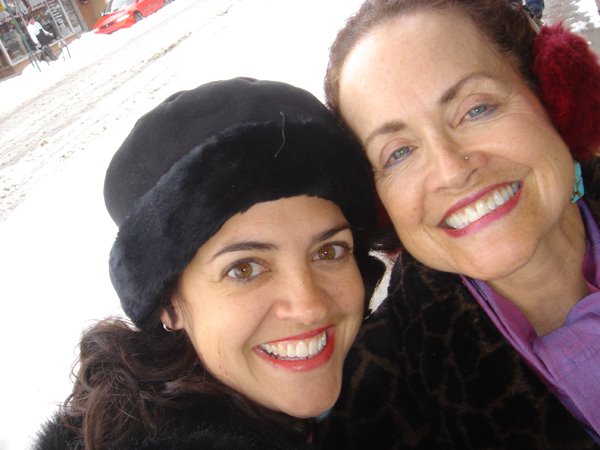
So in closing, I’d like to first say thankyou to my beloved mother who continues to be an incredible travel partner and my best friend. It is because of her that we traveled to China. And I thank her for that with all my heart!
And a big thankyou to all of the incredible friends we made during our journey through Sichuan, East Tibet, and Yunnan who make our short one-month trip look like a blink in time.
And lastly, a thankyou to the people of China who have broadened my perception of their country and of my own.
Besides the love of the adventure, travel also tends to sharpen my appreciation of the comforts of home. I was so elated to go to Trader Joe’s and pick out all the scrumptious food which I have missed….to take a shower without wearing flip flops…to travel on the bus without worrying about catching lice…and to return to a home of my own with the support and encouragement of my loved ones!
Please, if you are thinking of traveling but keep finding excuses and reasons NOT to…just do it. Book that ticket. Demand time off. It will change you and you won’t be sorry. If at the very least, it makes you appreciate everything you’re blessed with in this life.
Don’t let fear guide you. The adventure that lies ahead just may change you....
Cheers to all of you and thanks for reading…until next time!
Rachel "the jet-lagged one" Thurston


Monday, May 30, 2005

“Mice, Lice, and Asbestos”
East Tibet, Sichuan Region, China
5/30/05
Alas, our time in China is drawing to a close....we're going to miss the cheap prices, charismatic people, and side-stepping of spit globules on the sidewalks!
Perhaps I was a bit hasty when I spoke of how CLEAN China is. And perhaps I spoke a little too soon about how much I love the food here. After a month I have a more honest perspective of this country. Not overly romanticized, not overly jaded either. We've come to accept the condition of the toilets (from satisfactory to pretty dang nasty), the polluted air in the cities, the creative use of dog and fish eyes in the local cuisine, and the humidity in the lowlands in May. But it's been entirely worth it.....
We've returned from ten days driving and trekking in East Tibet, home of the Kham Tibetan warriors who are renowned for their horsemanship and use of bows and arrows. They're the cowboys of western Sichuan with their long black hair, strong builds, flowing furs, and silver daggers worn on their sashes.
We set out from Zhongdian, the border town between modern China and ancient Tibet. Where cowboys mix with yaks and motorcycles, where monks use cell phones, and where we shared a beautiful moment sharing a bag of BBQ potato chips with eight Tibetan grandmothers on a log under strings of prayer flags and a giant yawning blue sky. Zhongdian is the famed Shangri-La alluded to in James Hilton's novel, "Lost In Paradise." If you ask me, I don't think it's where Shangri-La was. James Hilton was either lost or really meant one of the villages and valleys further to the North.
Together with an Austrian woman, a British woman named Bridget, and a Dutchie named Michel, we hired Kevin, a Han Chinese guest house owner and driver with an SUV and bought several bags of noodles, tea, crackers, and chocolate. The next day, we set off for the North into and ascended the Tibetan Plateau with road heights averaging anywhere from 9,000 feet to 15,000 feet above sea level.
As we journeyed deeper into Tibet, the landscape shifted from steep pine forests and granite faces to large open expanses of landscapes of stone, snow, and grasslands that stretched deep into the horizon. The houses began as large two-story wooden homes with ornately designed windows--almost Moroccan in detail--and slanted roofs. We drove through high altitude villages (13,000 feet) where the local architecture shifted towards homes made of stone, prayer flags hoisted on each corner of the roof like castle turrets. Occasional mountainsides boasted giant stone graffiti in Tibetan letters spelling out the Buddhist Mantra, "Hail to the jewel of the lotus."
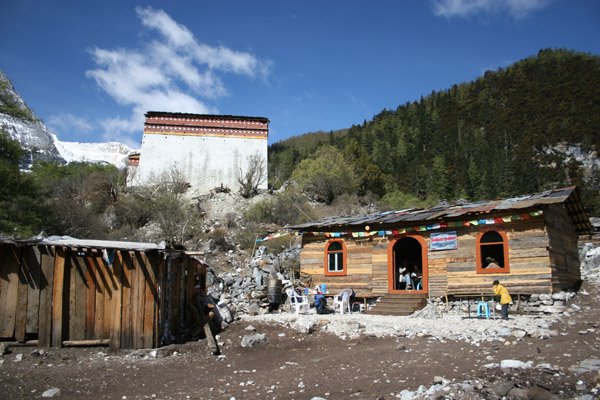
We traveled for four days to reach a special World Heritage Site called Yading where we rented horses for our bags and trekked along a sacred river to stay in the mountains near a monastery. Our little shack cost about $1 a night and was probably over-priced. We were surrounded by chickens, yaks, and horses and the beds were grungy at best but the view in the morning was phenomenal.
We awoke to a sun rising our the mountains and lighting up a giant meadow where long-haired yaks grazed alongside horses whose tails were braided with bright ribbons. Tibetan men and women--dressed in pink head dresses and wearing turquoise and coral jewelry--washed their faces in the river and walked through the forests in search of the famed "caterpillar fungus" which fetches a steep price in Asian medicine markets and has brought so much money into the area.
To our South was one of the three sacred mountains of the area which Tibetan pilgrims circumambulate with their prayer wheels and Buddhist beads. The weather in the mountains is mercurial and harsh. It would be hot and sweaty one minute and snowing ten minutes later. We visited a turqoise lake just below one of the glaciers...the only sound was an avalanche, wind, and a few birds.
The last night we stayed in the "chicken shack" I kept awakening to the sounds of mice and rats in the boards above my head. Once I finally fell asleep I was awoken again. This time to a reality and not a nightmare.
I could feel tiny little feet crawling across my eyes where my fleece hat was pulled over. By the time I was conscious enough to yelp, the mouse has made it across my face. I spent the rest of the night slapping at my blankets and cinching my sleeping bag around my neck.
"It can crawl across my face but I'll be damned if it makes it in my bag to spend the night!" I swore to myself.
In the morning, our British girlfriend Bridget started laughing when she saw me bump my head on the shack's roof and dust fell on my face.
"Have you guys noticed what our roof is made of?" she asked.
Mom and I looked up blankly-
"It's asbestos. If the bloody mice don't get you, then the asbestos will!" she laughed.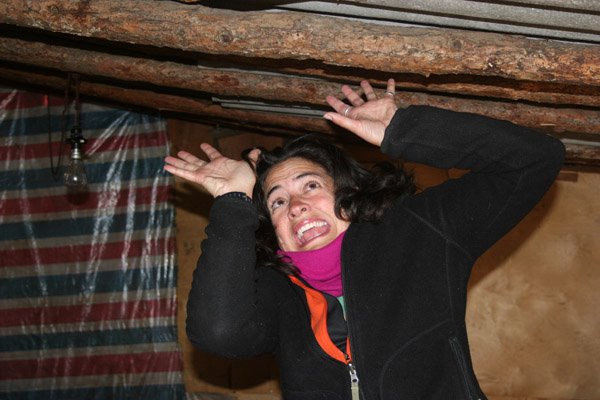
We were more than excited for showers and mice-free beds two days later.
Towards the end of our journey, we serendipitously landed in a town which was memorializing the death of a living Buddha. Yes, a dead living Buddha. Try translating that into English.
Thousands of different Tibetan groups were arriving by horse, tractor, and truck to pay their last respects to the man who had been the head llama of one of the region's most respected monasteries. We followed a river past grasslands where yaks were grazing and watched groups of men and women dressed in their finest attire cross the plateau on horseback. The women's hair braided with red ribbons, wearing long flowing robes and chunky turquoise earrings. The Tibetan men proudly wearing cowboy hats and long hand-crafted daggers. The horses were decorated with vivid carpets draped on their backs and bells and ribbons in their manes. Snow-capped mountains were the perfect visual backdrop to this exquisite scene of true nomads making a pilgrimage across the Tibetan grasslands.
One Khampa warrior raced his horse against a young guy on a motorcycle until he was overtaken by the dust and incomparable speed.
To me, it was the perfect vision of the clash in China between the ancient and the modern. The rush towards modernization. Instead of horses, many Tibetans are riding motorcycles now, the new steed of modern China.
From a hillside, we watched monks chanting beneath giant tents and lines of families waiting to prostrate and pray to the deceased living Buddha.
It's all so beautiful in images and words but it wouldn't be honest not to admit that the reality of life in Tibet is also harsh. The children have snot running down their noses like giant green caterpillars and people rarely bathe. Good dentistry is obsolete (though that's not disimilar from England). The streets are dusty and toilets are best avoided. The weather is mercurial. It's rainy and snowy and unforgiving. High altitude sickness and dehydration are daily challenges. Travel is rough and roads take you across several steep passes on a daily basis (from 9,000 to 15,000 feet).
It is not comfortable travel but, to us, it is entirely worth it.
After returning to the big city of Chengdu we traveled for the weekend to Xian, the ancient capital of China and home of the famed Terra Cotta Warriors--or the Eighth Wonder Of The World. We gorged on various and anonymous meats (one was chicken--I at least know that) on a stick, bowls of fresh watermelon, noodles, potstickers, and ice cream. We wandered through the Muslim Quarter shopping for tea and candied dried kiwi and nectarines. We watched a man hack apart a long spinal cord of some obscure animal and another guy weigh an armful of stomach linings.
Walking along a side street in China is not for the faint at heart.
Xian has a heartbeat of its own. It's lively and hip and balmy on summer nights. We walked across the main square beyond King Kong size billboards and watched dozens of people flying banners of kites. The strings were composed of miniature kites that stretched deep into the night sky where they disappeared into the darkness magically, as if suspended by some other invisible force on the other end.
On one of our last nights with our beloved Euro friends and our driver Kevin, we feasted at a Hot Pot Restaurant. Basically, a vegetarian's nightmare. But heaven to anyone who loves strange looking meat, hot food, and a social atmosphere.
Basically, the rules to eating Hot Pot are easy. One, you stack your plate with loads of food (frog legs, fish heads with eyeballs, bloody eels, chicken feet, and a few vegetables like potatoes, seaweed, and jicama) and you dump it into this boiling cauldron of oil and chili pepper that everyone sits around.
Secondly, you take a big drink of red wine or beer cause it supposedly makes you better with using chopsticks. Actually, this isn't true. At least for me. I dropped half of my food into mom's tea. All the frog legs, fish eyeballs, and vegetables churn around, soak up the juices of the hot pot and go swirling around the ring of boiling goo like an oceanic tempest. You eat whatever you can catch with your chopsticks. Then you lick your lips and go, "Hmmmm!" or you throw it on someone else's plate and say, "You really should try this, it has such an interesting crunch!"
Now, what I discovered is that if you drink a lot of Chinese wine and eat a lot of rice and make a couple of trips down to the local market for more bottles of cheap red wine, then most people, even the Chinese host, won't notice that you haven't eaten anything that was actually "cooked" in the hot pot. Which was the whole point of the dinner.
By the time, our meal was over, Bridget and I cared less about Hot Pot etiquette than we did before we started dinner. We started?quot;moonwalking" Jackson-style across the greasy floor of the restaurant and became embroiled in a brutal wedgie-war (she won, damnit! and I'm still sore) before the staff decided it was time to kindly throw us out and close the restaurant to anymore foreigners for the rest of the night.
Wisely, Mom and Kevin took a taxi back to the hotel while the four of us ambled into town in search of a discoteque. We managed to find one of the only English-speaking girls in the city who also wanted to go dancing. She whisked us down the street and into some funky little Chinese discoteque.
Before we knew it, we were drinking strange tea-flavored drinks, eating watermelon, and dancing barefoot on the stage with our new friends. By midnight, the music had switched from techno to Traditional Tibetan music and we were doing Tibetan line dancing with every Chinese guy and gal in the place. Behind us were video images of Tibetans dressed in traditional furs doing the danced in front of the Himalayan Mountains. We danced beneath hot strobe lights which made every one of our movements seem twice as complicated.
It was a surreal night. Very much like our entire experience here in China. Delightful and completely surprising.
I feel that we've only scratched the surface of this giant and incredibly diverse country. We're both anxious to return to this country. But for now, we have lived a lifetime in the past four weeks and we feel blessed for every moment of it!
We've also met such incredible friends on this journey. So many stories to share. Tonight we're off to eat Tex Mex food with our Dutchie friend Michel and pay tribute to our last night in China-
As Goethe once said or wrote or supposedly thought, "Whatever you dream of, do it. For boldness has magic and genius to it."
Something like that!
Goodbye and farewell crazy China!
Cheers, Rachel and her beloved Mamacita
Saturday, May 14, 2005
“The Wild, Wild West Of Yunnan and Sichuan”
Southwest China
5/14/05
Greetings From Tibet-
We've made our way up to the fabled town of Shangri-La, known as Zhongdian on Chinese Maps. We're at over 10,000 feet on the Tibetan Plateau and surrounded by wide open space, a yawning blue sky, and a crescent of snow-capped mountains.
This is a strange place. Where the old world meets the new world. Where the Chinese communist government and pressure to build new roads and new hotels clashes with the ancient way of the Tibetans. A collision of cultures and centuries. Part of the town is ugly and concrete and windswept but just a few steps outside of town and one runs into old Tibetan women in ancient dress and monks in burgundy robes.
We took a bus for 10 cents up to one of the largest Buddhist monasteries of Southwest China yesterday, climbing up the foothills to an even higher altitude. I was suffering from a bit of altitude sickness stumbling my way along the path and bumbling about with my camera unable to think straight or form complete sentences. Having altitude sickness is a little bit like being drunk...only without all the happy side effects.
We came to a large gompa built to represent the 13 steps to enlightenment and watched a Khampa Tibetan man carving Tibetan prayers into a slab of stone. The Tibetans here are called "Khampa," the famed warriors of East Tibet. The men are gifted horsemen and wear daggers on their belts. They are the ones who fought a fierce battle against the Chinese when the communist govt. took over Tibet. It is the Khampas who some other Tibetans fear for their fierce natures and physical build. The men and women are taller than other Chinese and have broad shoulders and thick black hair the color of ravens.
We walked beneath strands of shredded prayer flags fluttering in the mountain wind sending prayers off into the heavens on the backs of "wind horses," messengers of the sky.
A group of eight older Tibetan woman sat along a log chattering away as women do. They wore bright pink headscarves, long robes, and giant chunks of silver and turquoise jewelry. One of them motioned to mother and I and our Austrian friend to sit with them and share their space. I shared a bag of BBQ potato chips with the row of women, each of them cupping their hands and thanking us in Tibetan. Their faces were dark and handsome and deeply wrinkled from their years in the mountains. Their hands thick and strong. I wondered how many children they had seen born and how many children and grandchildren they'd raised....the countless baskets of wood they'd carried through the hills, the bread they'd made, and the loved ones they'd seen die through their lifetimes. They were completely beautiful.
Mother and I stood up to try to speak a couple of words to them in Tibetan. We started with "We are from America." Apparently, our pronunciation was a bit off because the women stayed silent and looked rather blank.
We tried again and this time two of the women winced painfully as if we'd just sung a Celine Dion song off key.
At last, they motioned it was time to go. Two of the women lifted our backpacks onto our backs as if they were full of feathers. We walked along the road with them until they headed in another direction towards their village.
The monastery's golden-leafed roof glimmered in the afternoon light and a cool breeze made the windchimes echo through the sky above us. We walked through the halls, the walls painted vividly with Buddhist deities in vibrant golds, blues, reds, and greens.
We lit incense and made prayers at one of the altars. A couple of monks noticed I couldn't stop sneezing from the dust and wind._The youngest one_pulled out a small glass jar and tapped a brown powder onto his thumbnail motioning me to take some and snort it through my nose.
Of course, curiosity overcame me and I tried it. It hit me hard with a sharp, pleasant strike to the right nasal cavity. "Hun hao!" I said with delight. "Very good!" He poured more onto my thumbnail, making sure to keep me from taking too much. It couldn't be_THAT illegal if a monk was offering it to me, right? _I snorted it again begging mom to try some, too. She'd already learned her lesson when she tried the last anonymous herb on our trek. She wasn't about to snort some strange looking powder up her nose.
A chinese woman told me later that it was tobacco home-grown by the monks. How they get the tobacco into such a tiny little bottle is a mystery to me.
We're headed to the North from here, deeper into the heart of East Tibet with a group of four other travelers (from Austria, U.K., and the Netherlands) and an English-speaking Chinese driver. We'll be throwing all of our bags onto the roof of the 4-wheel drive vehicle and cramming ourselves into the back.
We hope to drive through the mountains up to 15,000 feet and through the Tibetan grasslands where nomadic Tibetans will be camped with their mastiffe guard dogs.
From there, we'll head to Chengdu.
Adieu to you all,
Cheers, Rachel and her mum


